







































IDCDC-DIA-02 kuhleliwe
Academy · Outline ready
Amagagasi abantu base-Iran abahlala phesheya
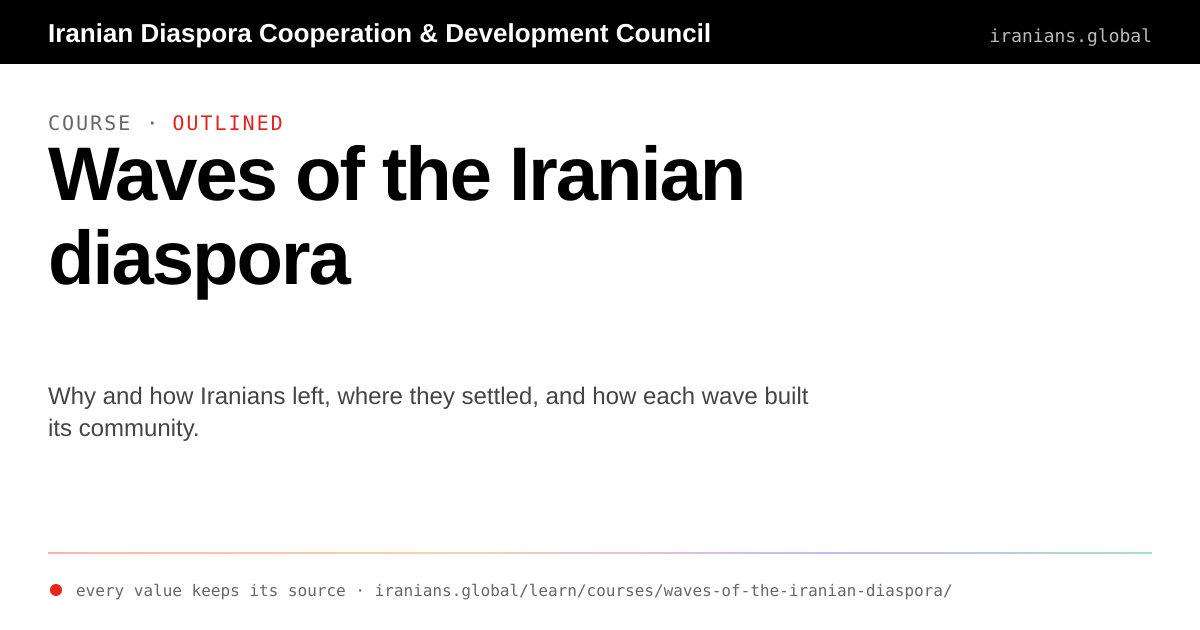
Why and how Iranians left, where they settled, and how each wave built its community.
The interactive map loads when you reach it. The list lists what it shows.
I-Akhademi Izifundo
The course
The Academy catalogue, read at 17c9a412e1IDCDC-DIA-01Uhlaka lulungile, alukavulwaIzisekelo
- Isikole
- Diaspora studies
- Ifakhalthi
- Ikhono Labahlala Phesheya, Umphakathi Nocwaningo
- Discipline
- Iranian diaspora studies
- Izinga
- Izisekelo
- Amahora
- 16 h (estimated)
- Format
- Self-paced online with family-history exercises.
- Kulabo
- Diaspora members of every generation, researchers and host-country partners.
- Prerequisites
- none listed
- Enrolment
- not open yet
- Learning platform
- Open for enrolment on study.iranians.global
A reviewer from the faculty reads the outline before the course opens.
Uhlaka
6 modules- Old dispersions
- Students and professionals before 1979
- 1979 and the 1980s
- 1990s to 2010s
- Recent departures
- Counting the diaspora
- Distinguish the main migration waves and their causes.
- Explain how statistics count, and miss, the diaspora.
- Compare the community's history in at least two countries.
- Record a family migration story with consent.
Every outline and module title of this course can be translated. Translating it into Persian (Farsi), English, South Azerbaijani (Azerbaijani Turkish) or another language of the network is a task that counts toward that language's course. Help translate
IDCDC-DIA-04 kuhleliwe
Abezindaba bokudingiswa nemisebenzi yamasiko
IDCDC-DIA-06 outline ready
Izifundo zabahlala phesheya 101
What a diaspora is, how scholars study it, and how to read the numbers.
For everyone from about age 14: young people, adults, parents and newcomers
- Modules
- 4
- Outcomes
- 4
- Before
- none
IDCDC-DIA-05 kuhleliwe
Isizukulwane sesibili nobunjalo
IDCDC-DIA-03 kuhleliwe
Iranians in Europe, North America and the Persian Gulf
Nothing matches.
This record · JSONMarkdownRSS · coursesAtomJSON FeedCSVJSONCardevery value keeps its source and label
Manje
Academy125 courses, none open for enrolment yetCivic3 campaigns, 5 programmesHeritage116 days to keep, 39 chronology entriesNews82 approved sources, no confirmed events yetChaptersforming. None is recognised yet